
Hawaiian Wedding Vows, Chants, Blessings & Traditions
Hawaiian Wedding Vows, Poems and Blessings
Hawaiian wedding vows are woven from chant, prayer and aloha. Here is how a traditional Hawaiian ceremony unfolds, from the Oli Aloha chant and the blowing of the pū to the lei exchange and the blessing of the rings, with words you can borrow for your own vows. Our Kahu and ministers can lead every part of it, in English and in Hawaiian.
A chant in Hawaiian, carried on the trade winds at Waimanalo, by Kahu Lei Hulu Mamo

A Hawaiian ceremony among the botanical gardens of Maui, led by Rev. Moses

The Oli Aloha: A Welcome Chant
To begin, the sweet sounds of the ukulele welcome guests as they reach the traditional Hawaiian wedding.
Then, once most guests are seated, the wedding officiant, usually a Kahuna Pule a.k.a. Kahu (Hawaiian minister) adorned with a flashy, leaf haku lei (head garland) recites a mele (chant), popularly Oli Aloha, as he escorts the groom to the forefront of the proceeding. The translation of this chant is:
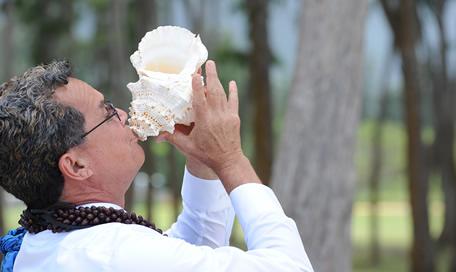
Paul blows the conch shell before every ceremony, calling forth the love that is present in all things
Kahu Rosemary chants a welcome as the couple arrives at Turtle Bay on the North Shore
At Aloha Island Weddings, every ceremony is created around you. We work with licensed denominational, non-denominational, interfaith and secular officiants, so your beliefs are honored in the way you choose. Whether you prefer traditional vows and rituals, something new or a mix of both, we will shape your ceremony until it feels just right.

Kahu Mahalani laughing with the couple about the deeper meaning of love
Words of the Oli Aloha
This is the sight for which you have longed.
Now that you have come,
Love has come with you.
There was a seeking of a loved one,
Now she is found—A mate is found
Someone with whom to share the chills of your winters
And the warmth of your summers.
Love has made a plea that you are to become united here in Hawaii.
Hawaii is a perch—a perch in the Heavens.
You two are now to become one for the day is here at last:
You are to be wed!

A blessing over plumeria leis on the sand at Waimanalo
Blowing the Pū, the Conch Shell
Next to come down the aisle are the mothers of the bride and groom with their escorts followed by the bridal party.
Then the ceremony continues with the Kahu blowing the Pu (conch shell) in all directions representing the repelling of antagonistic spirits and the calling forth of that which is harmonious, spiritual, sacred, and enduring.
Like a flute of the angels, the Pu reverberates through both breeze and wind
Summoning Laka, the Goddess of Love!
Because it can be heard for miles, the sound of the Pū, which is audible for miles, informs the elemental powers to be witnesses to the emergence of the bride:
O Earth, Wind, Fire, and Sea behold this divine festivity!

Kahu Lei Hulu Mamo smiles as the bride comes up the aisle, ready to bless them in Hawaiian

Kahu Kamana calls the bride with the pū under Yvonne and Dominic’s arch
The Bride’s Entrance
Often to the recitation of another chant by a Hawaiian chanter, the bride walks down the aisle alone. She and the groom alike are arrayed in white—he with a red sash around his waist and she frequently with a white haku lei as opposed to a veil. Once they are both at the head of the ceremony, the Kahu might say some words of assemblage like:
We gather here today to witness and celebrate the matrimonial commitment of Mary and John.
Not taken lightly is their pledge to accept one another
As lover, companion, and friend.
This union represents the fusion of two souls as one
And is intended never to be undone!
The Lei Ceremony
Although sometimes saved for other parts of the ceremony, the Kahu then performs yet another chant or says some appropriate words as the soon to be wed couple exchange leis (garland necklaces).
For example, the bride and groom sometimes walk down the aisle wearing each other’s lei and then trade them shortly after.
At other times, the bride’s lei for the groom is kept secure by the maid of honor, and the groom’s lei for the bride by the best man, or the flower girl may be the keeper of both leis until the appointed time to hand them over to the wedding couple for exchange. However, the Kahu frequently takes charge of the leis and presents them to the bride and groom at the commencement of the ceremony. As they upon one another bestow their lei, they might say:
Aloha, Accept and wear this lei as a symbol of my love for you this day
(followed by a kiss on the cheek), Honi honi

Maile wrapped in pikake, a bride’s gift to her new husband
Leis for the Bride and Groom
Traditionally, the standard for grooms is either a ti leaf or maile leaf lei. Sometimes, to add color, it is interwoven with fresh flowers such as tuberose or orchids of various colors. Bridal leis, on the other hand, are often made from pink and white pikake, white ginger flowers, white orchids, or white rosebuds. These different bridal flowers may also be interwoven in an imaginative design.

Guiding their hands through the ring exchange
Binding the Hands with a Maile Lei
Alternative points in the ceremony for the interchange of the leis are as part of the pledge or part of the ring exchange. However, should they be presented at the opening of the wedding, the Kahu might next use a maile leaf lei to tie lightly the hands of the bride and groom while reciting
Hand-in-hand may the two of you withstand
Whatever life brings that is unplanned.
And regardless to what others do or say,
Hand-in-hand may you always stay.
In this instance, the couple’s hands will remain tied while the Kahu guides them through the vow recital, which if secular (non-religious), might sound something like this:
Kahu Mahalani watches as the couple finishes their sand ceremony

Every color poured together: one family, unbreakable
Sample Hawaiian Wedding Vows
John/Mary do you receive Mary/John) as your lawful marriage partner.
In health and sickness,
In laughter and tears,
In times of strength and times of fears?
Do you vow never to be discouraging
Rather protecting, inspiring, and encouraging?
Do you pledge to never deliberately act out of place
Or bring upon her/him disgrace?
Do you promise to always be faithful and true,
And to cherish each other as very best friend
From this moment until your lives shall end?
John/Mary respectively respond: I do.
“I do!”
Should the lei necklace exchange occur after the vows, the Kahu might say:
These leis are the representation of the love for one another that you bear.
Let them dry in the air
that you may always remember the precious harmony that you now share.
The Ring Exchange
After the Hawaiian wedding vows and the lei exchange comes the ring exchange: The bride and groom might each repeat after the Kahu something like:
With this ring I confirm our union.
Accept it with all my heart and soul.
As we grow old and gray,
May it remind us of this wondrous day.
Adding a fire ceremony into your Hawaiian beach wedding

Ukulele, song and Kahu Kimo, sharing a beautiful day
Should the lei solemnity follow that of the ring, the Kahu will introduce it with some words like:
As you gift one another with the lei,
Be mindful that it like the ring is a token
of sentiments of Aloha too deep to be spoken..
The Pronouncement
Next, the Kahu might proclaim:
By the power vested in me by the state of Hawaii, I now pronounce you husband and wife.
Go forth joyfully to love and serve one another and humanity!
Finally, the Kahu blows the pū one last time to mark the end of the ceremony.
Before or after the reception, the Kahu completes your marriage license and files it with the State of Hawaii. You can then order certified copies of your marriage certificate from the Hawaii Department of Health. See our Hawaii marriage license guide.

A shaka from the Kahu: relax, hang loose, island style
Read more about each of our Hawaii wedding ministers.
Aloha Island Weddings
Hawaiian Cultural Practices for Your Wedding
A Hawaiian wedding is full of meaningful traditions. You can include as many or as few as you like, and your Kahu will explain each one to your guests.
- Oli (chant): the ceremony often begins with an oli, like the Oli Aloha, chanted in Hawaiian to welcome the couple and their guests. E komo mai, welcome.
- The pū (conch shell): blown in all directions to call forth what is harmonious and sacred, and to announce the bride. See our conch shell ceremony.
- The lei ceremony: the couple exchange leis as a symbol of love and respect, often maile for the groom and pikake, plumeria or orchids for the bride, sealed with a honi, a kiss on the cheek. Many couples also give leis to their parents and family. See our Hawaiian flower leis.
- Binding of the hands: the Kahu may lightly tie the couple’s hands with a maile lei while they say their vows.
- Blessing of the rings: the rings can be blessed in a koa wood bowl, with a Hawaiian prayer.
- Sand ceremony: each of you pours a color of sand into one vessel, a union that can never be separated. See our Hawaiian sand ceremony.
- Haku lei and kihei: the bride may wear a haku flower crown, and some Kahu wear a kihei, a traditional cloth over the shoulder.
- Music and hula: ukulele, a Hawaiian song or a hula dancer can carry the aloha spirit through your day. See our wedding music and hula dancers.
- Flowers for loved ones: some couples place flowers in the ocean to remember family who have passed.
Meet Some of Our Hawaii Ministers
We offer many styles of ministers, so your ceremony fits your beliefs and your style. Here are a few of the ministers and Kahu we work with on Oahu:
- Kahu Lei Hulu Mamo: traditional Hawaiian vows and non-religious ceremonies, with chanting, Hawaiian prayers and a beautiful singing voice.
- Kahu Mahalani: Hawaiian Christian prayers, a conch shell entry and blessings with songs. He plays Hawaiian music and is happy to customize your ceremony.
- Pastor John Fuchigami: raised in Hawaii, Senior Pastor of Hope Chapel Iwilei, with well over 10,000 weddings since 2003. He offers Hawaiian style, Japanese, Filipino and Catholic style and traditional ceremonies, and can include a kihei, the conch shell, a koa bowl ring blessing, a sand ceremony and Hawaiian prayers.
- Rev. Kimo: raised on Oahu and lived 25 years on Maui. Hawaiian Christian, non-denominational and custom vows.
- Rev. Alan Fisher: non-denominational and traditional Christian ceremonies. He often sings the Hawaiian Wedding Song on his ukulele after the lei exchange.
- Rev. Chris Cain: non-denominational weddings in Honolulu since 1996. A down to earth minister who loves surfing and Hawaiian culture, and he speaks Japanese.
- Rev. Kahu Mike: relaxed and friendly, he loves to arrive early to greet your guests, with services in English and Japanese.
- Rev. Frank Mack: licensed to perform weddings in Hawaii since 2001, able to officiate in Chinese, including Mandarin, and Japanese.
- Rev. Reigh: a native of Honolulu, ordained as a Hawaiian non-denominational minister since 1972.
- Paul: our own Paul, who blows the conch shell to begin the ceremony and leads lei exchanges, sand ceremonies and vow renewals.
Every one of our ministers is licensed by the State of Hawaii. Meet them all on our Hawaii wedding ministers page.
Choose Your Hawaiian Minister
Our licensed ministers lead Christian, non-denominational and non-religious ceremonies, and many share Hawaiian traditions like the Oli Aloha chant, the blowing of the conch shell, the lei exchange and the blessing of the rings in Hawaiian. Meet them on our Hawaii ministers page, and see how a sand ceremony or conch shell can make your vows even more meaningful.
Aloha Island Weddings · 1154 Fort Street Mall, Suite 210, Honolulu, HI 96813

Hi Paul,
We would like more information about Kahu Kimo and Kahu Mahalani. Do they deliver the same vow? This is what we are looking for:
Light mood/light hearted (not comedic), In between comedy and completely serious, sincerity, a touch of spirituality, and NO CHANTS please.
Perfect yes fairly similar on the ceremony flow of the wedding , though each minister has their own personal touch . I will check on their availability
and send you a sample of one of their wedding ceremony vows.
BTW : usually both of these Hawaiian ministers ask for
the couple to say a few words from their heart to each other as personal vows too .
More info may be found at our minister page here : https://www.alohaislandweddings.com/hawaii_ministers1.htm
Thank you so much!
Hiya! I know this is kinda off topic nevertheless I’d figured I’d ask. Would you be interested in trading links or maybe guest writing a blog post or vice-versa? My website addresses a lot of the same subjects as yours and I feel we could greatly benefit from each other. If you are interested feel free to shoot me an email. I look forward to hearing from you! Awesome blog by the way!
Aloha,
I am reaching out to inquire about availability and pricing for a wedding officiant My partner and I are going to be getting married on Waimanalo Beach (we’ll have a campsite at the Waimanalo Bay Beach Park, aka Sherwood’s). I have secured the necessary permit and insurance policy. It will just be myself, my fiancé and my brother. We are looking for a non-denominational officiant and would like someone that can integrate traditional Hawaiian cultural practices. I have been dancing hula for ten years and am part of a halau, so integrating these aspects into our wedding ceremony is important to us. We would love to have someone that can oli and use traditional Hawaiian plants.
We already have video and photo taken care of, and are planning on going to get the license the week prior to the ceremony, so we just need a person to officiate.
I look forward to hearing from you. Mahalo nui,
Thankyou for the comment , though we are not doing weddings at Waiamanlo beach any more